
Best Online Casino Bonuses No Deposit 2026
Most advice about no-deposit bonuses starts with the same promise: free money, no risk, easy win. That framing is why so many players end up disappointed.
A no-deposit bonus isn’t really free money in the practical sense. It’s a marketing offer with rules attached, and the rules decide whether the bonus has real value or just looks attractive on a banner. If you treat the headline amount as the value, you’ll read the offer wrong from the start.
The better way to look at online casino bonuses no deposit is this: you’re being given a small, controlled trial budget. In exchange, the casino sets limits on where you can use it, how quickly you must use it, how much play counts toward conversion, and how much of any win you can keep. That doesn’t make the offer useless. It makes it something you need to price properly.
The math matters more than the slogan. A small bonus with simple terms can be worth more than a bigger-looking offer with harsh restrictions. A short expiry can destroy value. A low game contribution rate can turn a quick conversion into a grind. A cashout cap can erase most of the upside even if you play well.
If you want to use these offers intelligently, stop asking “How much free money is this?” Start asking “What does it cost me in playthrough, time, game choice, and withdrawal limits?”
Table of Contents
- Introduction Unpacking the Free Money Myth
- What Are No Deposit Bonuses Really
- The Catch Dissecting Wagering Requirements and Caps
- How to Evaluate a No Deposit Bonus Offer
- Safely Claiming Your No Deposit Bonus Step by Step
- Beyond No Deposit Smarter Bonus Alternatives
- The Final Verdict and Legal Landscape
Introduction Unpacking the Free Money Myth
The phrase “free money” hides the only part that matters. Control sits with the terms, not the headline.
Casinos use no-deposit offers to reduce friction at sign-up. That’s the point. They want a new player to register, explore the platform, try selected games, and possibly make a first deposit later. From the operator’s side, the bonus is an acquisition tool. From the player’s side, it should be treated as a test environment with constraints.
That difference in perspective explains why so many bonus pages feel generous until you read the conditions. The casino isn’t handing out unrestricted cash. It’s giving you a conditional opportunity. Sometimes that opportunity is worthwhile. Sometimes it’s barely usable.
Practical rule: Don’t judge a no-deposit bonus by the amount credited. Judge it by how easily that amount can become withdrawable money.
New players usually get stuck in three places. First, they confuse bonus balance with cash balance. Second, they underestimate how much wagering changes the effort required. Third, they ignore limits on eligible games, timing, and withdrawals until they try to cash out.
A smarter approach is to ask a few blunt questions before claiming anything. What exactly do I receive? What must I do before withdrawal is allowed? Which games count fully, partially, or not at all? Is there a cap that limits the upside even if I get lucky?
Those questions strip away the sales language. They also reveal why the actual math behind online casino bonuses no deposit is usually less exciting than the banner, but far more useful than the banner if you know how to read it.
What Are No Deposit Bonuses Really
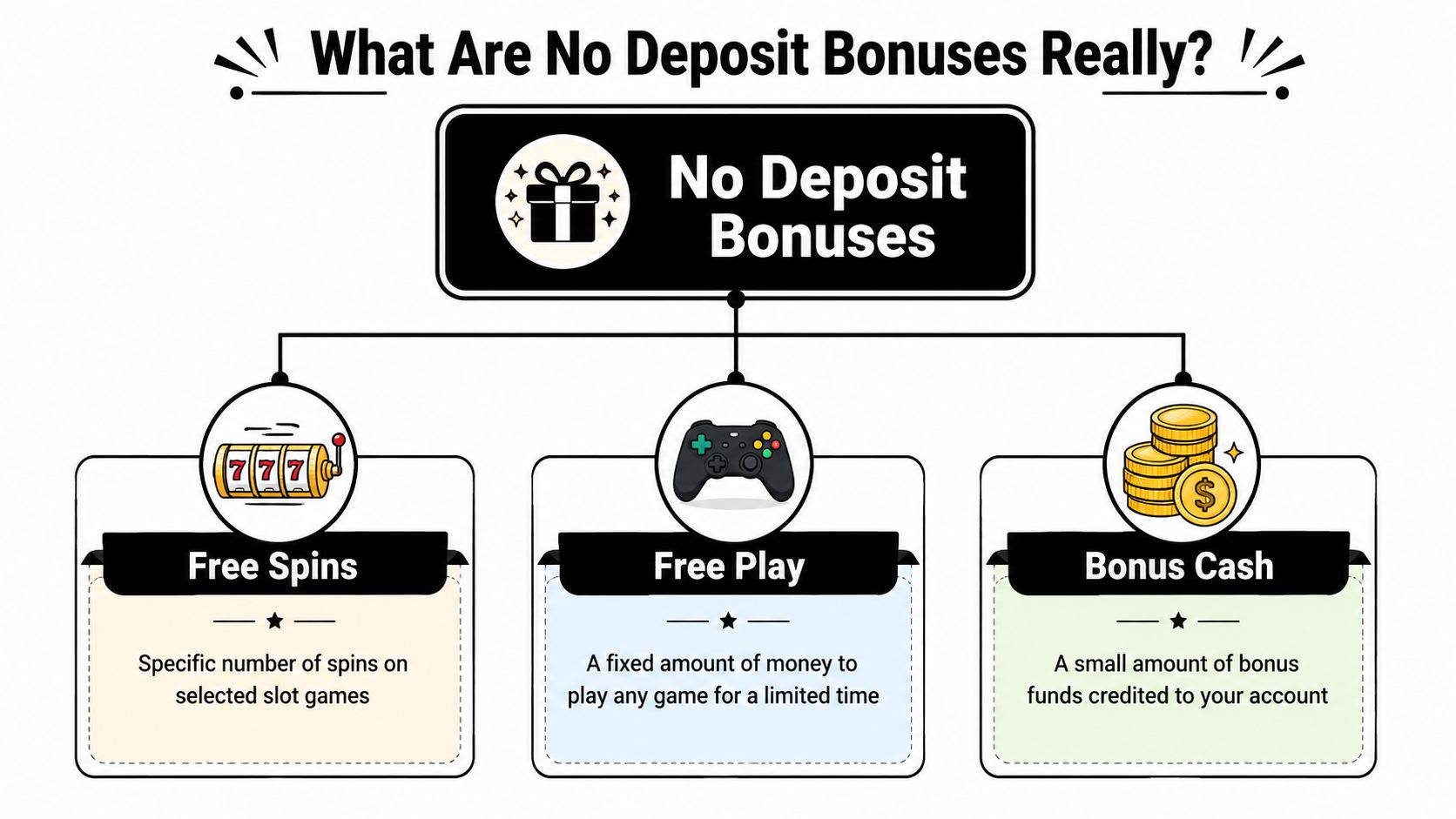
A no-deposit bonus is a sign-up incentive that credits bonus funds, free spins, or similar trial value after registration without requiring an initial deposit. Its practical value is usually limited by wagering requirements and withdrawal caps. Published offers in major markets commonly pair a small grant with terms ranging from 1x to 60x wagering and maximum cashouts such as €50 to $200, as explained in Covers’ guide to no-deposit casino bonuses.
The three forms you’ll see most often
Most online casino bonuses no deposit fall into three practical categories.
Bonus cash is the easiest to understand. It operates much like a small gift card, though subject to certain restrictions. The casino credits a fixed amount to your bonus balance, and you can use it on approved games. The catch is that you usually can’t withdraw it directly. You must first meet the playthrough rules tied to it.
Free spins work more like tokens for a specific slot. You don’t choose any game you want. The casino tells you which slot qualifies, and the spins apply there. If you win from those spins, the winnings often move into a bonus balance that carries its own rules.
Free play or trial credits sit somewhere in between. They act like a temporary spending allowance inside the casino. You may get more flexibility than with fixed free spins, but the operator still controls where and how the value can be used.
Why the headline number is rarely the true value
A beginner often sees the word “free” and assumes the value equals the amount shown. That’s the first mistake.
If a casino gives you bonus cash but limits your withdrawal, the value isn’t the headline amount. If it gives free spins on a slot you don’t want to play, the value isn’t the advertised spin count. If winnings require heavy turnover, the offer may be more like a small audition than a real cash gift.
The useful question isn’t “What do I get?” It’s “What part of this can realistically become money I control?”
This is why experienced players read no-deposit offers as rule packages, not gifts. The bonus itself is only one line in that package. The rest is where the true value lives or dies.
The Catch Dissecting Wagering Requirements and Caps
A no-deposit bonus stops looking generous once you treat it like a math problem instead of a gift.
The part that matters most is not the headline amount. It is the distance between the bonus and cash you can withdraw. Wagering requirements, game weighting, expiry rules, and cashout caps all add friction. Each rule lowers either your chance of finishing or the amount you can keep if you do finish.
How wagering requirements change the value
A wagering requirement is the amount of total betting you must complete before bonus winnings can be withdrawn. The easiest way to read it is as required turnover.
Start with a simple comparison. A $10 no-deposit bonus with 1x wagering asks for $10 in total bets. The same $10 bonus with 40x wagering asks for $400 in total bets. The offer amount did not change. The workload and risk did.
That difference matters because bonus balances are small. Small balances do not tolerate long betting runs well. The more times you must recycle the same money through a game, the more chances variance has to wipe it out before you clear the terms.
A good mental model is a short fuel tank on a long trip. A light wagering requirement may let the balance reach the finish line. A heavy one often means the fuel runs out first.
The rules that reduce an offer
Wagering gets the attention, but several smaller rules often decide whether a bonus has any real value.
One common trap is the time limit. If the casino gives you only a short window to use the bonus, the offer starts controlling your pace of play. That can push players into rushed decisions, which is the opposite of how disciplined bonus play should work.
Another trap is partial game contribution. Slots often count more fully toward wagering than table games or live dealer titles. So a player might bet for an hour on blackjack, see plenty of action, and still make far less progress than expected. The visible effort feels large. The credited progress is small.
Then there are the hard caps:
- Maximum cashout caps limit how much bonus-derived money you can withdraw.
- Maximum bet rules can void winnings if you stake more than the terms allow while the bonus is active.
- Game restrictions can limit you to a narrow list of eligible titles.
- Short expiry periods can force you to finish on the casino’s schedule.
A bonus with easy entry and harsh exit rules is usually built to attract registrations, not to create withdrawable value.
Sample Game Contribution Percentages
The table below shows the kind of contribution pattern players often run into. It illustrates the concept, not a universal rulebook.
| Game Type | Contribution Percentage |
|---|---|
| Slots | Often full contribution |
| Table games | Often partial contribution |
| Live dealer games | Often partial contribution |
Many new players often misread their progress. If a game contributes only part of each wager toward the requirement, then $100 bet does not always count as $100 cleared. It may count as a fraction of that amount.
That changes the cost of the bonus in two ways. First, it takes longer to finish. Second, the longer you play, the more exposure you have to normal game variance.
One final filter matters just as much as wagering. The withdrawal cap sets the ceiling on what you can keep. If a bonus lets you win $120 but the terms cap bonus withdrawals at $50, the extra $70 was never part of the bonus’s practical value. Two offers with the same bonus amount can produce very different outcomes for that reason alone.
The useful habit is to read every no-deposit offer in this order: wagering requirement, game contribution, expiry, maximum bet, and cashout cap. That sequence shows the true price of “free.”
How to Evaluate a No Deposit Bonus Offer
A good no-deposit bonus should survive a basic inspection. If it doesn’t, skip it. There’s always another promotion.
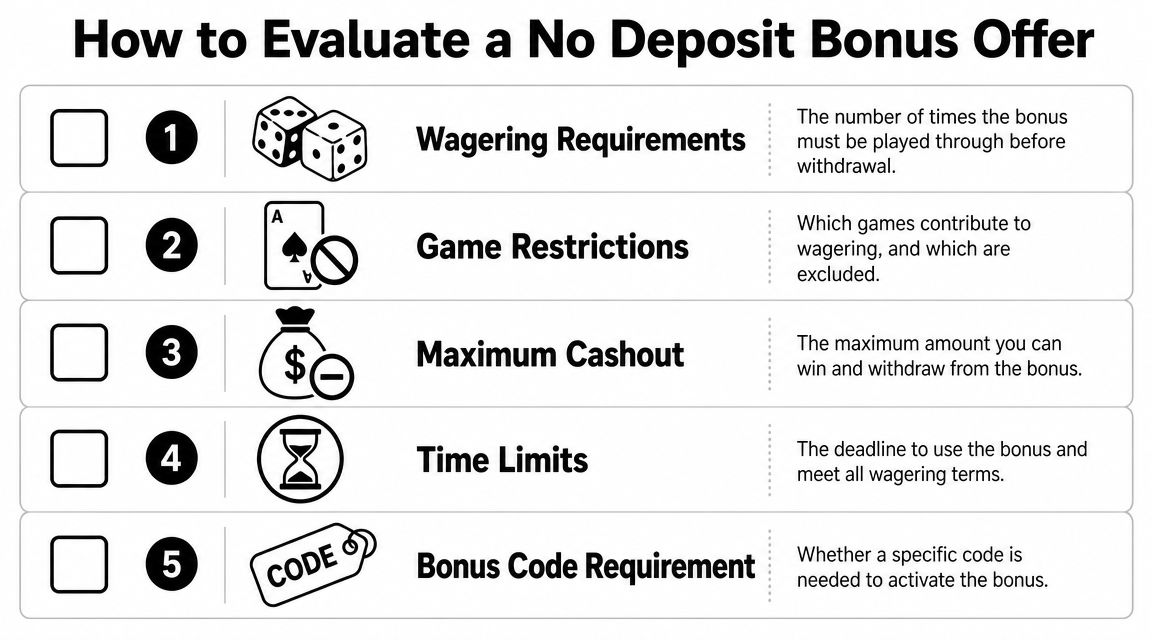
A practical checklist before you click claim
Use this as a pre-flight check, not a legal exercise.
- Read the full bonus terms: Don’t stop at the promo banner. Find the rules on wagering, excluded games, expiry, and withdrawal conditions.
- Check the operator’s license and reputation: You want a casino that states who regulates it and how account verification works.
- Identify the exact bonus type: Bonus cash, free spins, and free play aren’t interchangeable. Each creates different limits and different expectations.
- Look for the withdrawal path: Find out what documents or verification steps the casino may request before release of winnings.
- Confirm whether a code is needed: Some offers activate automatically. Others are not applied if you miss a promo code at registration.
A short visual guide can help when you’re comparing offers side by side:
Red flags that make a bonus less useful
Some offers aren’t scams. They’re just badly structured for players.
Watch for terms that are technically clear but practically harsh. These include tiny eligible game lists, vague wording about “management discretion,” or bonus conditions buried across several pages. If you can’t tell how the bonus converts after a careful read, the offer is already too expensive in attention.
A strong evaluation question is this: would you still claim the bonus if the banner amount were removed and only the rules remained? If the answer is no, the value probably came from the marketing, not the mechanics.
Quick check: A usable bonus has terms you can summarize in plain English after one read. If you can’t, pause before claiming it.
Safely Claiming Your No Deposit Bonus Step by Step
Claiming a no-deposit bonus safely is less about speed and more about accuracy. Most withdrawal problems start at registration.

Set up the account correctly the first time
Start with a casino you’ve already screened. Then register using your real legal details. Don’t shorten your name, don’t use an old address, and don’t create a second account because you forgot a password. Bonus systems and compliance checks often flag mismatches long before a withdrawal request is reviewed.
If the offer requires a code, enter it exactly as shown. Then confirm that the bonus appears in the right balance and under the expected terms. If the promotion doesn’t credit as described, contact support before you start playing. It’s easier to fix a claim issue before wagering begins than after.
For help with routine account and bonus issues, a clear first stop is the Casino Prestige support page.
Handle verification before you think about cashing out
Many players wait until they’ve won something to think about verification. That’s backward.
Casinos usually want proof that you are who you say you are and that you’re allowed to play in the relevant jurisdiction. That can include identity checks and payment-related verification if you later deposit or withdraw. If your account details don’t match your documents, the bonus itself may not be the problem. Your setup is.
A careful claiming routine looks like this:
- Choose the offer after reading the rules
- Register with exact real information
- Activate the promotion correctly
- Check which games are eligible before you wager
- Track your progress and expiry manually
- Complete verification early if the casino allows it
- Attempt withdrawal only after confirming the bonus has fully converted
That process sounds boring, but boring is good. Boring is how players avoid avoidable disputes.
Beyond No Deposit Smarter Bonus Alternatives
A no-deposit bonus helps with one narrow job. It lets you test the casino before you put your own money at risk. Once you move past that trial stage, the better question is not “Where is the free bonus?” It is “Which offer gives me the best value for the way I play?”
That shift matters because bonus math changes fast when your own deposit enters the picture. A larger headline offer can still be poor value if the wagering load is heavy, the game weighting is weak, or the maximum cashout is tight. In other words, a bigger number on the banner does not mean a better deal in practice.

Why regular players move past no-deposit offers
No-deposit bonuses are built like a sample spoon at an ice cream shop. You get enough to judge the flavor, not enough to count on as a meal.
For a repeat player, the limits show up quickly. The starting balance is small. Eligible games may be restricted. Winnings are often capped. Even if the bonus is fair, the expected return in dollars is usually modest because the casino has fenced it in from several directions.
A deposit offer can make more sense because it gives you more usable bankroll. Cashback can make more sense because it reduces the cost of a losing stretch. Ongoing rewards can make more sense because they spread value across many sessions instead of forcing all the value into one sign-up moment.
Bonus structures that deserve a closer look
The main alternatives are easy to name, but they should be judged with the same math-first approach used for no-deposit offers.
- First-deposit match bonuses: These suit players who want more playing funds up front and are willing to compare playthrough, game contribution, and withdrawal terms.
- Cashback offers: These suit players who prefer predictable loss recovery over chasing a large but conditional bonus balance.
- Loyalty and VIP systems: These suit players who return often enough to collect repeated benefits such as customized promos, better cashback rates, or faster support handling.
Here is the practical test. If Bonus A gives you a large match but asks for heavy wagering, and Bonus B gives you smaller weekly cashback with fewer restrictions, Bonus B may produce more real cash over a month. Bonus value is not just the amount offered. It is the amount you can reasonably convert, plus the time and risk required to get there.
That is why some experienced players focus less on welcome pages and more on long-term reward structure. The Casino Prestige VIP program is one example of a tiered system built around recurring benefits instead of a one-time free-entry promotion. That model will not suit everyone, but it fits players who care about repeat value more than a small sign-up teaser.
A no-deposit bonus is a test drive. Your bonus strategy gets more serious once you start measuring cost, conversion odds, and staying power.
The Final Verdict and Legal Landscape
What these bonuses are actually good for
No-deposit bonuses are useful when you treat them as trial tools. They let you inspect a casino’s interface, game loading, payment flow, support responsiveness, and bonus clarity without starting with a deposit. Used that way, they’re practical.
They become disappointing when players expect them to function like unrestricted cash gifts. The bonus amount is usually the least important line on the page. The important math sits in the playthrough rules, restrictions, and cashout conditions that determine whether the offer is worth your time.
Why availability depends heavily on where you live
In regulated U.S. online casino markets, true no-deposit bonuses remain relatively small and geographically limited. As of June 2026, the typical range is $10 to $25 in credits, with a common 1x wagering requirement, and these offers are concentrated mainly in New Jersey, Pennsylvania, Michigan, and West Virginia, according to Action Network’s regulated market overview of no-deposit casino bonuses. That legal concentration matters because it shows these promotions aren’t broadly available across the U.S. market.
The legal environment also explains why modern offers look controlled and conservative. Licensed operators must fit promotions inside jurisdiction-specific rules, compliance checks, and state-by-state market conditions. If you want a grounded example of how a modern online casino is positioned, this Casino Prestige review of its hybrid crypto-fiat setup gives useful context for comparing structure, payments, and bonus design.
The final verdict is simple. Online casino bonuses no deposit can be worth claiming, but only if you calculate them like a player, not like a marketer. Read the rules, price the effort, and treat the offer as a controlled experiment. That mindset turns a flashy promo into a rational decision.
If you want a casino platform with clearly defined promotions, crypto and fiat payment options, sportsbook access, and an ongoing rewards structure that goes beyond one small free-entry offer, take a look at Casino Prestige.